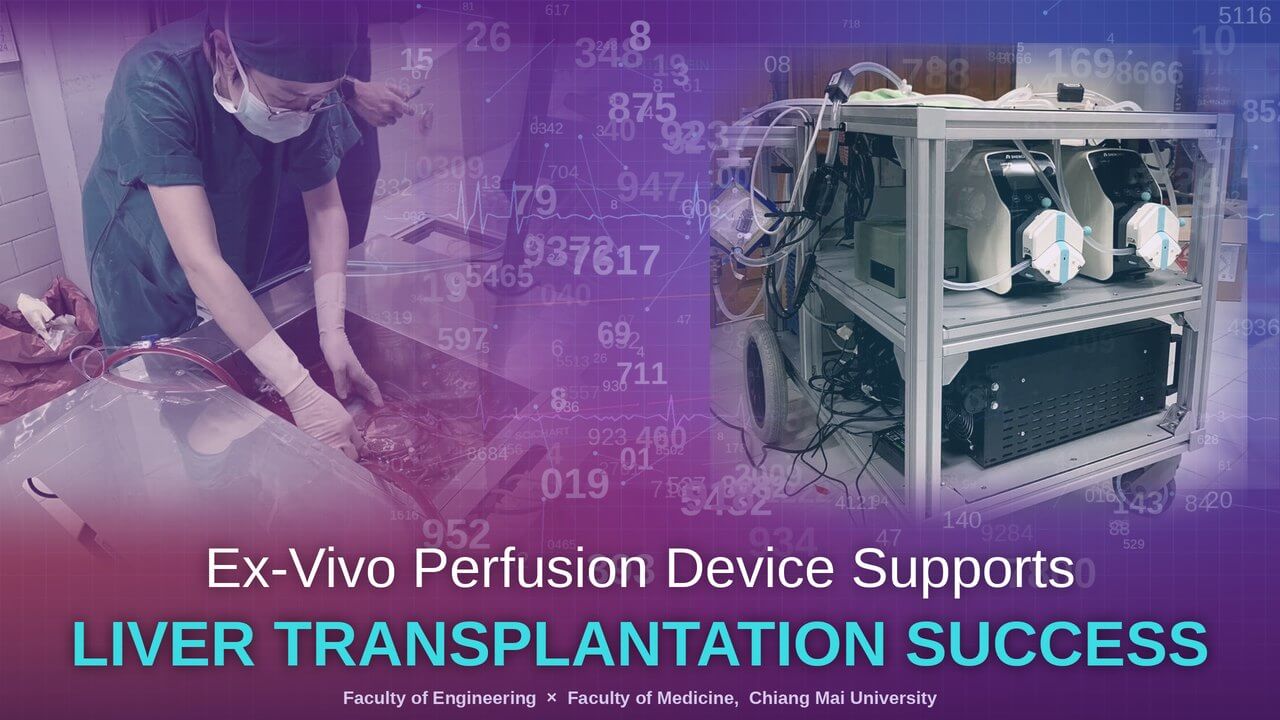
Application: Perfusion device for enhancing liver transplantation success.
Principal Investigator: Assoc. Prof. Dr. Konlayutt (Tom) Punyawudho, Chiang Mai University
Assoc. Prof. Dr. Konlayutt (Tom) Punyawudho, from Chiang Mai University spearheaded an investigation into a new ex-vivo perfusion device. The aim was to increase the success rate of liver transplants to give more patients the potentially life-saving treatment they need faster.
What Is the Perfusion Device Designed For?
The perfusion device is built on the principle of Biomimetic Dynamic Perfusion. It’s designed to simulate the human body’s physiological environment to restore liver organs outside the body. The methodology integrates fluid kinematics, gas exchange, and advanced thermal management.
What Were the Technical Requirements for this Project?
This project required data visualization to be predictably real-time and accurate to support effective clinical decision making.
Operational Principles & Methodology
- Dual-Circuit Biomimetic Flow: The system uses two independent peristaltic pumps to mimic natural blood flow. The Portal Vein circuit handles up to 1,500 ml/min (max 150 mmHg), while the Hepatic Artery circuit handles up to 700 ml/min (max 150 mmHg).
- Advanced Thermal Control: An integrated small chiller and heat exchanger unit allows precise temperature regulation ranging from -20°C to 80°C. This enables advanced sub-zero ‘super-cooling’ preservation.
- Real-Time Viability Monitoring (Crucial Data Aspect): Before fluid enters the liver, it passes through an array of sensors. These sensors continuously measure pressure, flow rate, and temperature. The high-frequency data is processed by a central microcontroller and must be rendered in real-time for clinical observation.
Clinical Applications & Operations
The perfusion device is deployed in three primary modes for clinical operations:
- Hypothermic Machine Perfusion (HMP) at 4°C: Utilized for restoration of organs suffering from prolonged ischemia. It facilitates mitochondrial restoration and reduces early allograft dysfunction.
- Normothermic Machine Perfusion (NMP) at 34-37°C (Decision Support Platform): Operates as a real-time assessment platform for high-risk or marginal organs. By visualizing lactate clearance and monitoring bile production, surgeons can make quick, data-driven decisions on whether an organ is viable for transplantation.
- Nanomaterial-Enhanced Therapeutic Perfusion: An advanced phase using Cerium Oxide nanomaterials within the perfusate. The aim is to treat and recover organs at the molecular level by reducing ischemia-reperfusion injury (IRI).
What Was SciChart’s Role in the Project?
As our system acts as a life-support and diagnostic platform for organs, the precision, reliability, and speed of our user interface are paramount.
We require a high-performance rendering engine to visualize continuous, high-frequency time-series data (pressure, flow rate, temperature, and biochemical markers) without latency.
SciChart empowered our ‘Integrated Viability Assessment’ dashboard, allowing surgeons to monitor the organ’s status and make critical transplant decisions.
“SciChart gives us the real-time performance and reliability required to visualize continuous pressure, flow, temperature, and biochemical data from our ex-vivo liver perfusion system. Its high-performance rendering enables our clinical team to monitor organ behavior without noticeable latency and supports rapid, data-driven viability assessments during perfusion.”
Assoc. Prof. Dr. Konlayutt (Tom) Punyawudho, Principal Investigator, Chiang Mai University
Achieve Similar Results with Support from SciChart
If you’re investigating a pioneering medical device to provide better healthcare, and need high-performance data visualization to get there, SciChart might just be the solution you’ve been looking for.
We’re used by 90% of the leading medical device companies around the world. Join the healthcare revolution and achieve genuine progress with help from SciChart’s real-time and highly-customizable chart library for complex medical charts.