
SciChart’s Cross-Platform Vision Complete!
SciChart has achieved a great deal in the past year, notably the pace of large releases has really increase in […]
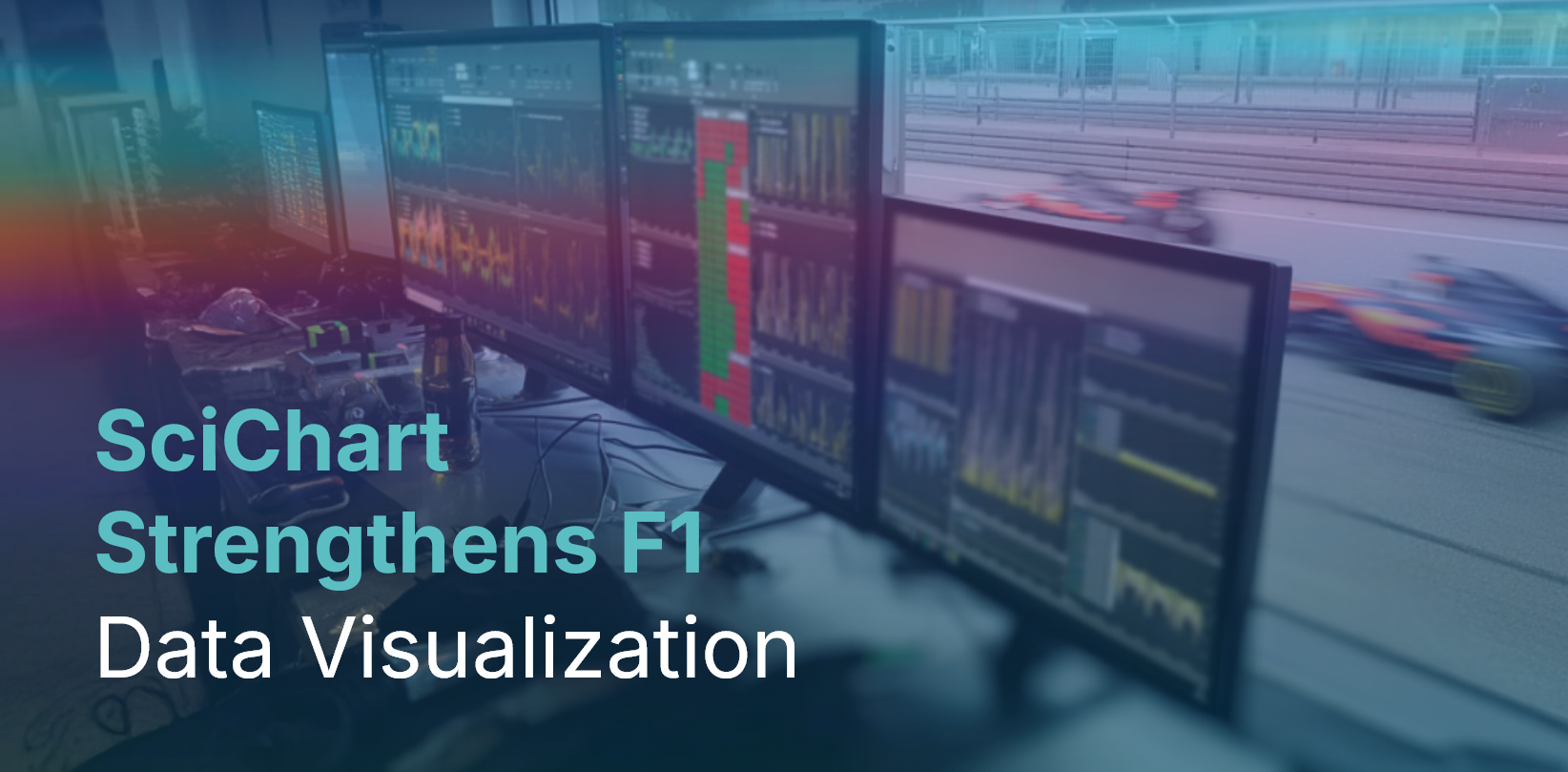
SciChart is increasing adoption of its technology across Formula 1 (F1), reinforcing our role as a key visualization layer behind many of the sport’s most advanced telemetry and engineering workflows. We’re used by team built engineering tools and widely deployed through commercial analysis platforms across the F1 grid.
Our GPU-accelerated F1 data visualization supports race weekend operations, simulation workflows, wind tunnel correlation, power unit development, tyre performance modelling and live telemetry systems. This includes both bespoke internal software developed by teams and paddock wide applications used throughout motorsport.
Our technology has also been selected by at least one future manufacturer program in advance of public entry, an indication of how new entrants are investing in software first engineering infrastructure long before debuting a car.
Formula 1’s financial regulations and cost caps have shifted competitive advantage away from unlimited physical testing and toward software optimization, simulation efficiency and faster interpretation of high frequency engineering data.
As development budgets get tighter, teams naturally lean harder into tools that can squeeze out maximum insight per simulation run, reliably correlate disparate data streams, and shave off crucial milliseconds in the heat of a live race decision.
There’s intensified demand for F1 sensor data visualization that can operate with extremely low latency, render complex multi-signal datasets without numerical distortion, and support real-time engineering work where milliseconds influence results.
Teams increasingly replace older visual layers with modern GPU-accelerated engines, an area where SciChart has steadily emerged as a trusted standard for high frequency engineering applications.
“Under the cost cap, performance is no longer only mechanical, it’s computational. Formula 1 teams need to extract maximum insight from every sensor, every lap and every simulation. Our goal is to ensure their engineers can see more, understand more and act faster,” said Andrew Burnett Thompson, Founder and CEO of SciChart.
Formula 1 engineering environments typically involve hundreds of sensor channels and highly granular data sampled at high rates. And that’s not to mention all the rigid timing and bandwidth constraints. The ability to correlate multiple signals instantly across aero, chassis, power unit and driver input data has become central to modern F1 live data analysis and subsequent engineering.
SciChart’s rendering engine is specifically architected to process massive, fast-moving datasets without the need for downsampling, dropped frames, or any hint of numerical degradation. This lets engineers operate with complete signal fidelity, which is key when you’re trying to visualize those rapid, fleeting, or transient behaviors. It’s unparalleled real-time performance that supports 100 million data points without lag.
Our technology is deployed across a wide range of motorsport engineering workflows, including:
As more teams adopt modular development approaches with internal software supplemented by proven commercial components, SciChart’s footprint has grown both directly and indirectly across the grid.
In recent years, we’ve seen strong growth in motorsport, driven by the rising importance of software-driven engineering. Other contributing factors include the need to visualize increasingly complex telemetry environments, and long-term programs from both existing teams and new manufacturers. Broader engineering trends, including heavier reliance on simulation, correlation loops and sophisticated sensor fusion, continue to expand the need for high precision, real-time visualization.
“The engineering culture in Formula 1 is evolving. Teams are building more of their own software and relying on visualization that is instantaneous, reliable and exact. Our momentum reflects that shift, and the fact that our technology is now used across the grid, whether through internal systems or external platforms, shows how central real-time visualization has become to modern race engineering.” said Sheldon Vestey, Chief Commercial Officer at SciChart.
The same rendering technology used in Formula 1 is now foundational in other sectors facing similar challenges. Think high frequency data streams, low latency decision cycles, multi-signal correlation and the requirement for numerical accuracy at scale.
These include:
Formula 1’s high pressure, data intensive environment has become a proving ground for the visualization technologies now shaping next generation engineering across multiple industries.
About SciChart
SciChart is a high-performance data visualization engine used globally in scientific research, financial trading, aerospace, defense, automotive engineering and advanced industrial systems. Available across Windows WPF, JavaScript WebGL and Mobile iOS Android, SciChart enables real-time rendering of large and complex datasets with GPU acceleration and high numerical precision. Its technology powers mission critical systems for Fortune 500 companies, pioneering engineering teams and national research programs worldwide.
Related Posts

Queens Award for Innovation
Proud winners of the Queens Award for Innovation, 2019. Awarded on account of our innovative graphics engine which underpins the SciChart library and enables our world-beating charting performance

National Business Awards
Highly Commended for Lloyds National Business Awards, 2019. Awarded on account of our innovative graphics engine and impressive customer base

National Technology Awards
Awarded “Healthcare Tech of the Year” at the 2025 National Technology Awards – a top UK recognition for breakthrough innovation in technology.

Reviews
SciChart has received hundreds of verified, 3rd party reviews