
SciChart.js v5.1.0 Released!
Just six weeks after the release of SciChart.js v5.0, we have another minor update for you: SciChart.js v5.1.0. In this […]
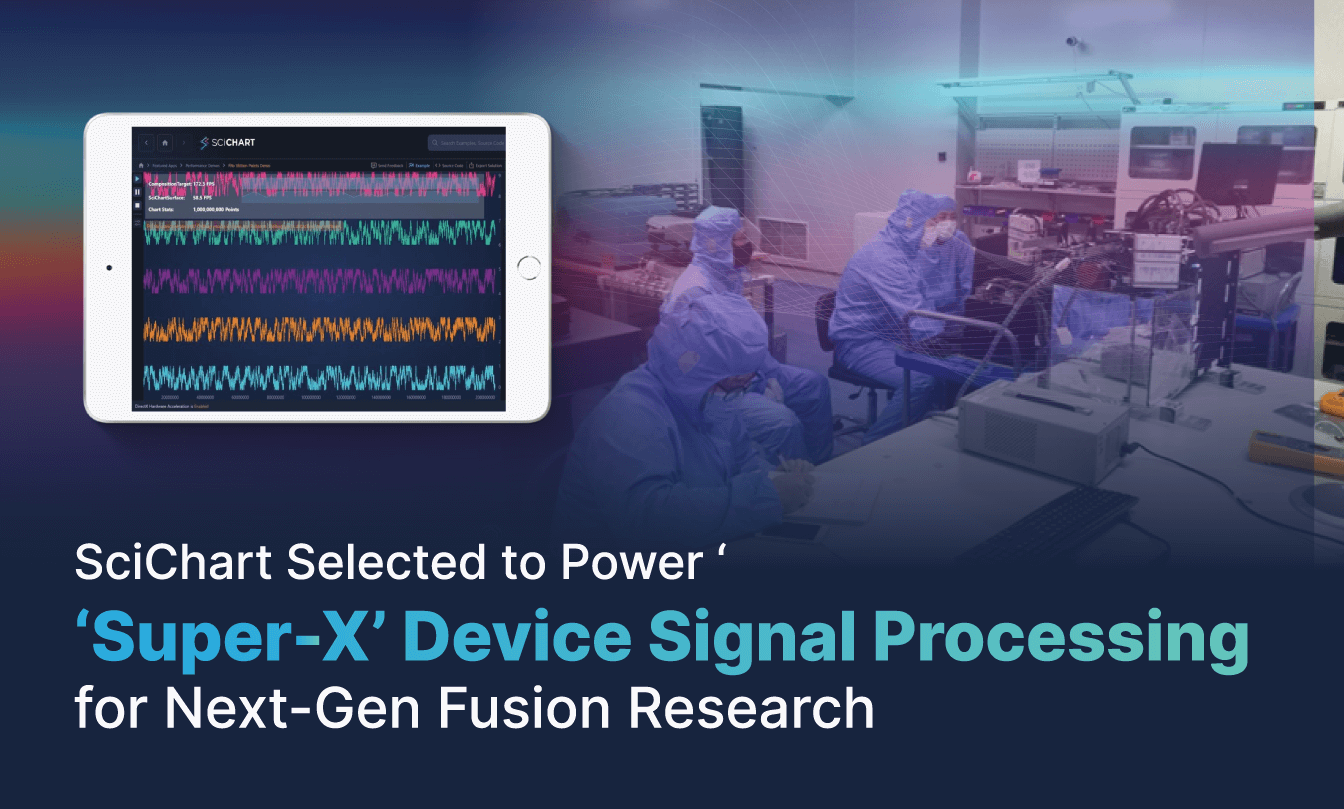
SciChart is to power the next generation of nuclear fusion research at the Institute of Plasma Physics, Hefei Institute of Physical Science in China.
As part of a collaboration with the Chinese government, SciChart will provide advanced signal processing and real-time data visualization capabilities for the Super-X device—an experimental superconductor evaluation platform designed to test and validate high-performance superconducting components critical to future fusion reactors.
SciChart’s integration into the Super-X system supports China’s strategic nuclear fusion initiative by enabling precise monitoring and analysis essential for the development of reliable, large-scale superconducting magnet technologies.
Superconductors are fundamental to the operation of advanced fusion reactors, enabling the generation of strong magnetic fields required for plasma confinement with minimal energy loss.
High-performance superconducting materials allow for compact, efficient, and stable magnet systems that can sustain the extreme conditions necessary for controlled nuclear fusion.
Devices like the Super-X play a pivotal role by testing and validating these superconductors under realistic operational conditions. This ensures their reliability, guides material and design improvements, and supports the development of scalable, next-generation fusion reactors such as the China Fusion Engineering Test Reactor (CFETR).
Robust superconductor technology is essential to making fusion energy both feasible and economically viable.
The Super-X device plays a critical role in evaluating the performance of superconducting components for magnetic confinement fusion reactors.
With its ability to support high-intensity magnetic fields and precise temperature management, the device is an essential step toward the realization of the China Fusion Engineering Test Reactor (CFETR).
The specialized equipment will underpin the next phase of design, emulation and testing in superconducting components. The newly developed platform will assess the capabilities of materials and designs to test their suitability for the extreme conditions of nuclear fusion.
The device’s groundbreaking architecture includes over 800 engineering and experimental signal channels. It’s anticipated that data will be collected from two 60-day cycles each year.
Researchers will be able to access these data sets reliably in real-time, manage emulations, and assess novel design architecture. By leveraging SciChart, they’ll be able to run comparative analyses with previous data and develop new visualizations, all without slowdown.
About SciChart: SciChart is the world’s fastest, precision data visualization software, used by top global companies in sectors ranging from healthcare, signal processing and engineering to aerospace and scientific research. Offering cross-platform compatibility, precision rendering, and unparalleled performance, SciChart is trusted for applications that demand speed and accuracy in real-time data analysis. SciChart is found everywhere, from the F1 racetrack to NASA mission command centers and pioneering research.
Signal processing is the discipline of capturing, analyzing, and manipulating signals—such as electrical, optical, or acoustic waveforms—that represent varying physical phenomena. It involves techniques like filtering, digitization, and frequency analysis to extract meaningful information from raw data in real-time.
In engineering and scientific applications, signal processing enables accurate monitoring, control, and interpretation of system behavior, especially in environments requiring high-speed, high-fidelity data analysis.
China’s Super-X device is a critical platform for high-precision signal processing in the evaluation of superconducting technologies for future fusion reactors. It enables real-time acquisition and analysis of complex data from numerous engineering and experimental sensors, ensuring accurate, reliable measurements.
Key stages include:
The Super-X device’s advanced signal processing capabilities support both real-time monitoring and long-term research, advancing China’s efforts in practical nuclear fusion development.

Due to their custom requirements and intense performance and accuracy needs, signal processing faces significant challenges in data visualization.
Below is a summary of the issues faced by the fusion research team, many of which are also faced by MedTech research and development teams:
SciChart excels where generic tools like MathWorks Simulink or non-specialised charting libraries fall short. This is particularly noticeable for high-performance, specialized signal processing applications where advanced scientific research, real-time monitoring, and large-scale data analysis are required.
Unlike generic chart libraries, SciChart offers:
Signal Processing Data Visualization for Design, Test and Emulation
Whether you’re looking for signal processing or design, emulation and test software solutions, SciChart enables our clients to create custom, cutting-edge solutions pushing the boundaries of research and development.
Our high-performance rendering engine, designed with novel requirements and research in mind, can help you bring your next project to life on anything from mobile devices, to embedded hardware or remotely accessible browsers.
SciChart is the only precision 64-bit library built for data accuracy and integrity available on WPF, JavaScript, iOS, Android and MacOS with support for Linux.
Related Posts

Queens Award for Innovation
Proud winners of the Queens Award for Innovation, 2019. Awarded on account of our innovative graphics engine which underpins the SciChart library and enables our world-beating charting performance

National Business Awards
Highly Commended for Lloyds National Business Awards, 2019. Awarded on account of our innovative graphics engine and impressive customer base

National Technology Awards
Awarded “Healthcare Tech of the Year” at the 2025 National Technology Awards – a top UK recognition for breakthrough innovation in technology.

Reviews
SciChart has received hundreds of verified, 3rd party reviews