iOS & macOS charts - Examples
Please note! These examples are new to SciChart iOS v4 release! SciChart’s OpenGL ES and Metal iOS and Metal macOS Chart library ships with hundred of Objective-C and Swift iOS & macOS Chart Examples which you can browse, play with and view the source-code. All of this is possible with the new and improved SciChart iOS Examples Suite and demo application for Mac, which ships as part of the SciChart SDK.

Demonstrates how to add an Overview Chart to provide intuitive navigation of large datasets. This example shows how a synchronized overview surface can be used to control the visible range of the main chart, enabling smooth pan and zoom interactions.
The overview controls the visible X-axis range via shared ISCIRange updates and supports configurable viewport selection, zooming, and panning behavior.
SCIChartOverview *overviewChart = [SCIChartOverview new];
[self.view addSubview:overviewChart];
self.overviewChart.createOverviewChart(forParentSurface: self.surface)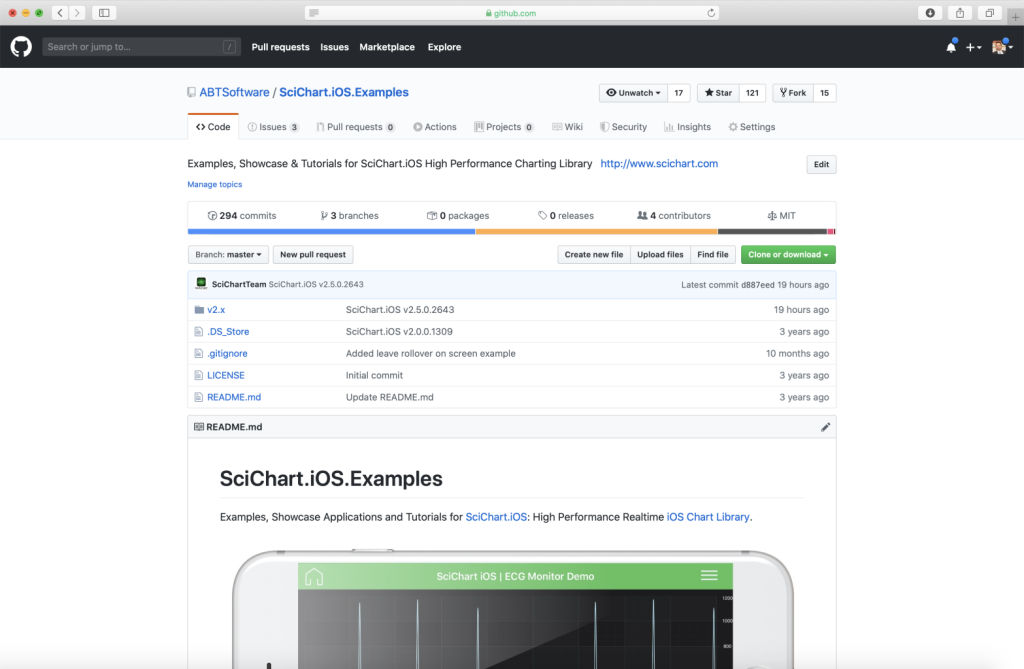
The Swift and Objective-C source code for the iOS & macOS Overview Chart example is included below (Scroll down!).
Did you know that we have the source code for all our example available for free on GitHub?
Clone the SciChart.iOS.Examples from GitHub.
Also the SciChart iOS and Scichart macOS Trials contain the full source for the examples (link below).
OverviewChartView.swift
View source code//******************************************************************************
// SCICHART® Copyright SciChart Ltd. 2011-2019. All rights reserved.
//
// Web: http://www.scichart.com
// Support: support@scichart.com
// Sales: sales@scichart.com
//
// RealtimeTickingStockChartView.swift is part of the SCICHART® Examples. Permission is hereby granted
// to modify, create derivative works, distribute and publish any part of this source
// code whether for commercial, private or personal use.
//
// The SCICHART® examples are distributed in the hope that they will be useful, but
// without any warranty. It is provided "AS IS" without warranty of any kind, either
// expressed or implied.
//******************************************************************************
class OverviewChartView: SCDOverviewChartViewControllerBase {
override func initExample() {
let xAxis = SCINumericAxis()
let yAxis = SCINumericAxis()
let count = 1500
let randomWalkGenerator = SCDRandomWalkGenerator()
let data1 = randomWalkGenerator.getRandomWalkSeries(count)
let randomWalkGenerator1 = SCDRandomWalkGenerator()
let data2 = randomWalkGenerator1.getRandomWalkSeries(count)
let randomWalkGenerator2 = SCDRandomWalkGenerator()
let data3 = randomWalkGenerator2.getRandomWalkSeries(count)
let ds1 = SCIXyDataSeries(xType: .double, yType: .double)
ds1.seriesName = "Line Series"
ds1.append(x: data1.xValues, y: data1.yValues)
let ds2 = SCIXyDataSeries(xType: .double, yType: .double)
ds2.seriesName = "Mountain Series"
ds2.append(x: data2.xValues, y: data2.yValues)
let ds3 = SCIXyDataSeries(xType: .double, yType: .double)
ds3.seriesName = "Column Series"
ds3.append(x: data3.xValues, y: data3.yValues)
let rSeries1 = SCIFastLineRenderableSeries()
rSeries1.dataSeries = ds1
rSeries1.strokeStyle = SCISolidPenStyle(color: 0xFFFF70FF, thickness: 2)
let rSeries2 = SCIFastMountainRenderableSeries()
rSeries2.dataSeries = ds2
rSeries2.strokeStyle = SCISolidPenStyle(color: 0xFFe9Fe64, thickness: 2)
let rSeries3 = SCIFastColumnRenderableSeries()
rSeries3.dataSeries = ds3
rSeries3.strokeStyle = SCISolidPenStyle(color: 0xFFe97064, thickness: 2)
let legendModifier = SCILegendModifier()
legendModifier.margins = SCIEdgeInsets(top: 60, left: 10, bottom: 16, right: 16)
SCIUpdateSuspender.usingWith(self.mainSurface) {
self.mainSurface.xAxes.add(xAxis)
self.mainSurface.yAxes.add(yAxis)
self.mainSurface.renderableSeries.add(rSeries3)
self.mainSurface.renderableSeries.add(rSeries2)
self.mainSurface.renderableSeries.add(rSeries1)
SCIAnimations.wave(rSeries1, duration: 3.0, andEasingFunction: SCICubicEase())
SCIAnimations.wave(rSeries2, duration: 3.0, andEasingFunction: SCICubicEase())
SCIAnimations.wave(rSeries3, duration: 3.0, andEasingFunction: SCICubicEase())
self.mainSurface.chartModifiers.add(items:SCIPinchZoomModifier(), SCIZoomPanModifier(), SCIZoomExtentsModifier(), legendModifier)
/// Create overview
let customView = self.createCustomGripView()
let options = SCIOverviewOptions()
var filteredSeries: [ISCIRenderableSeries]
filteredSeries = self.mainSurface.renderableSeries.toArray().filter({ series in
if series.isKind(of: SCIFastMountainRenderableSeries.self) {
return false
}
return true
}).map { series in
if series.isKind(of: SCIFastLineRenderableSeries.self) {
let rSeries = SCIFastMountainRenderableSeries()
rSeries.dataSeries = series.dataSeries
return rSeries
}
return series
}
options.renderableSeries = NSMutableArray(array: filteredSeries)
//Custom Grip
self.overviewChart.createOverviewChart(forParentSurface: self.mainSurface, grip: customView, options: options)
//Default Grip
// self.overviewChart.createOverviewChart(forParentSurface: self.mainSurface, options: options)
}
}
}