WPF Chart - Examples
SciChart WPF ships with hundreds of WPF Chart Examples which you can browse, play with, view the source-code and even export each WPF Chart Example to a stand-alone Visual Studio solution. All of this is possible with the new and improved SciChart WPF Examples Suite, which ships as part of the SciChart WPF SDK.
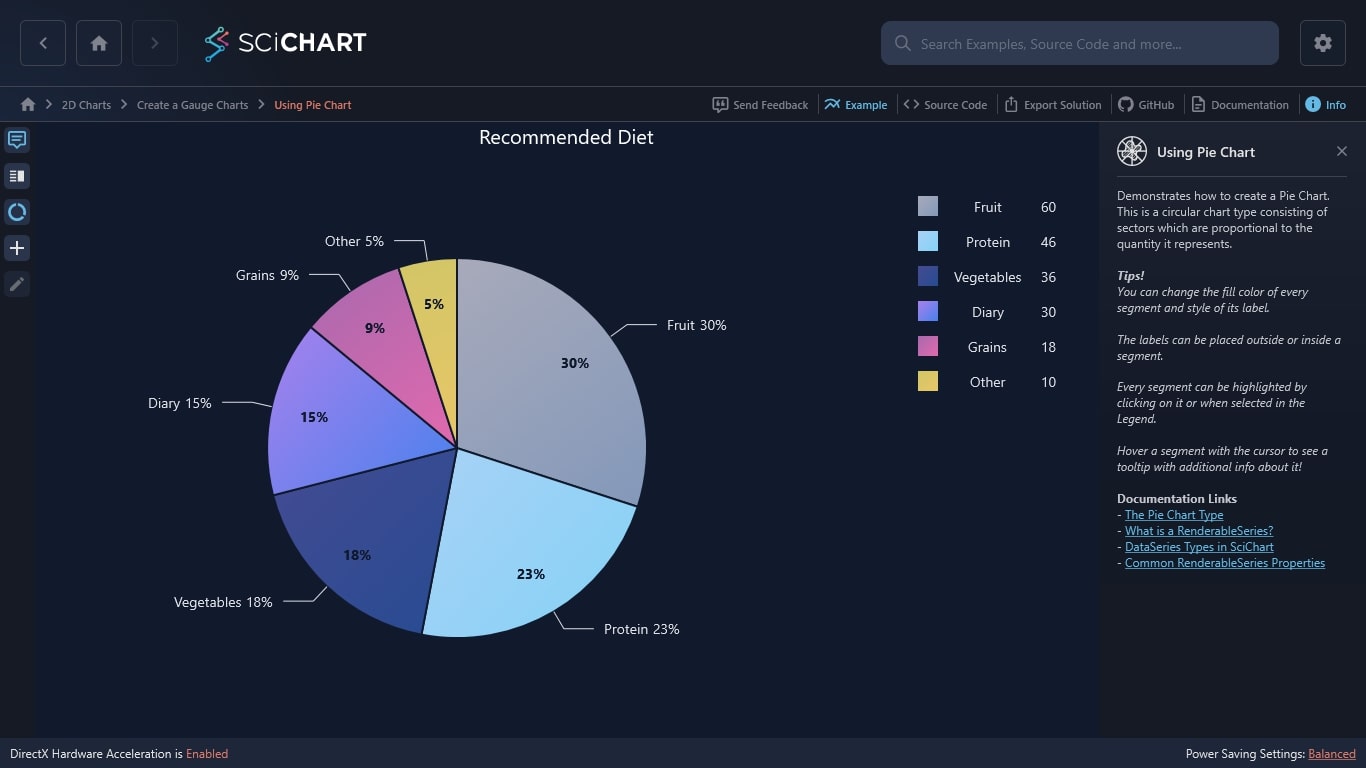
This WPF Pie Chart example from our WPF Charting Software demonstrates how to create a circular pie chart. This chart consists of sectors that are proportional to the quantity they represent. It’s a more basic chart, but it’s a popular way to easily visualize the comparison of data categories, either in percentages or volumes.
Whether you work on web applications for motorsports, healthcare, financial, trading, robotics or research, if you’re looking for enterprise-level charts, we have the high performance WPF charting software you want.
Create Your WPF Pie Chart With SciChart in 3 Simple Steps
The C#/WPF source code for the WPF Pie Chart example is included below.
You can also view the source code from one of the following sources:
- Clone the SciChart.WPF.Examples from GitHub.
- View source in the SciChart WPF Examples suite.
- The SciChart WPF Trial also contains the full source for the examples.
Download the WPF pie chart examples or begin your free trial today.
Documentation Links
- The Pie Chart Type
- What is a RenderableSeries?
- DataSeries Types in SciChart
- Common RenderableSeries Properties
Getting Started Couldn’t Be Easier
Ready to get started with your free 30-day trial? Read our Getting Started with WPF guide. This will help you:
- Begin your free trial
- Create charts with tutorials
- Compile example source code
- Access documentation
So, what are you waiting for? Bring that WPF data visualization project to life with a free trial of SciChart WPF. Simply download and install.
Get Started With SciChart WPF Today
Why Use SciChart?
With SciChart, you can power simple and complex charts. We provide endless color and styling customizations so you can stay on brand and create highly engaging data visualizations. Offering the fastest WPF charts earned us a National Technology Award in 2025. We don’t just stop at providing the best software, we also provide an excellent customer experience. Find out why 98% of our customers recommend us – download your free trial today and see what’s possible.
We’re built for every chart project, from producing beautifully-designed pie charts all the way up to the most complex, big-data charts. With regular updates to our charting software, you can trust that we have your back and that our GPU-accelerated Visual Xccelerator™ can confidently handle all your WPF data visualization requirements.
Ever had the frustration of trialling code to find it doesn’t work? You won’t have that problem with SciChart. We’ve mission-tested our WPF Pie Chart example code to ensure it works!
- Fast rendering for real-time data feeds
- SciChart WPF handles billions of data points
- No freezing dashboards, even after 100M+ data points
- Supports endless customizable features
- 5-star rated support for developers
- Built-in AI support to help you build faster
- Extensive features built for complex charts
- 98% of users recommend SciChart
Frequently Asked Questions
How easy is it to change the WPF Pie Chart color?
You can easily change the colors of pie chart segments using the Color property in IPieSegmentViewModel. Or, colors can be added automatically from the SciChartPieSurfaceBase.BrushesCollection. You have the option to override with custom colors. If you don’t provide colors they will be randomly created. View our Pie Chart Type Documentation for more information.
How many developers per licence?
Each licence is designed for one developer. Each individual who compiles, debugs, or develops code using SciChart’s packages needs to have their own license. However, you do not need to purchase a license for build servers, CI/CD servers or testers.
Can my developers access technical support – even on the free trial?
Yes – If your developers have a question or need technical support, our expert customer response team will be able to help within a prompt timeframe. We also have hundreds of resources available across our website, as well as AI support for instant answers.
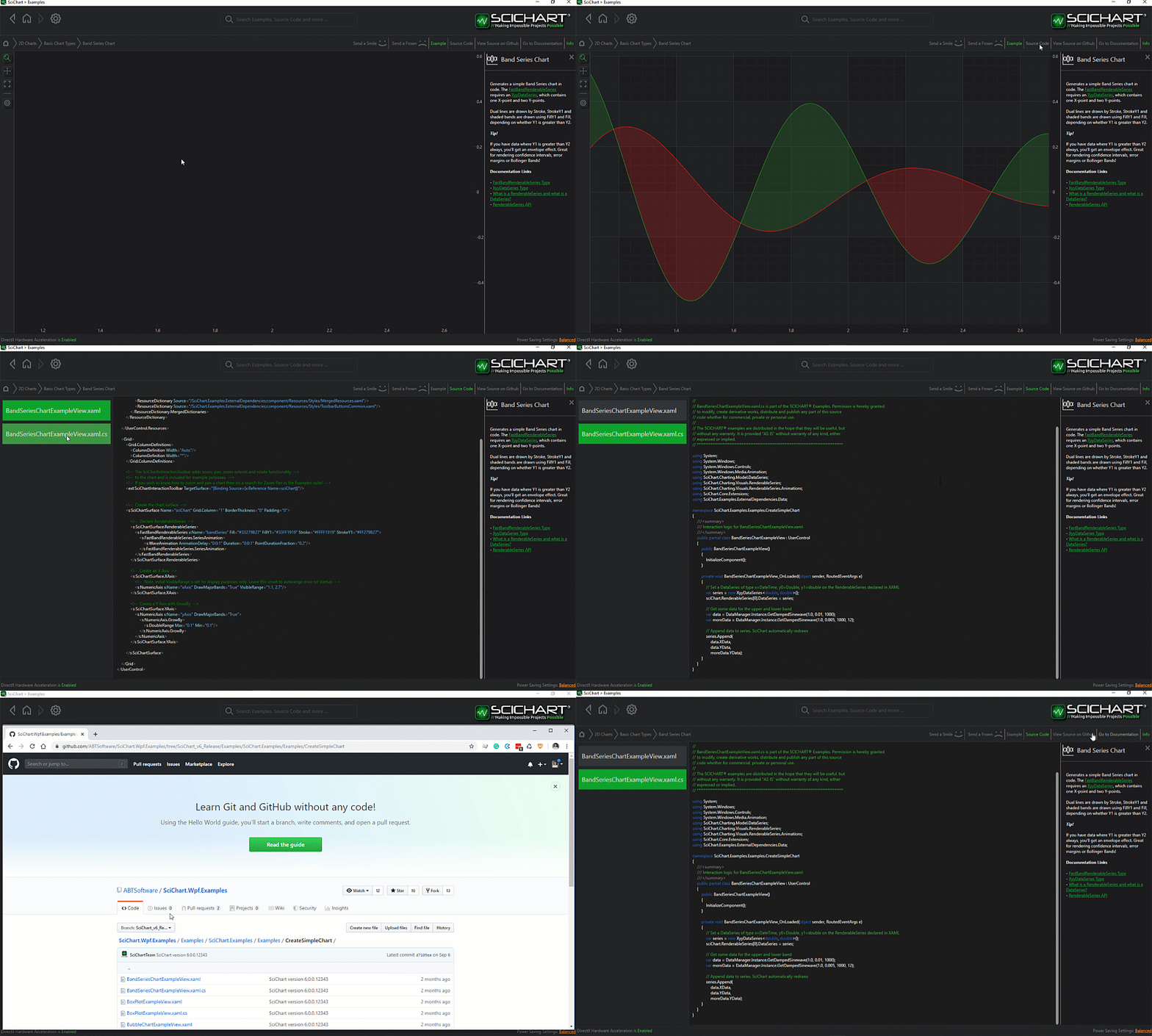
The C#/WPF source code for the WPF Pie Chart example is included below (Scroll down!).
Did you know you can also view the source code from one of the following sources as well?
- Clone the SciChart.WPF.Examples from Github.
- Or, view source in the SciChart WPF Examples suite.
- Also the SciChart WPF Trial contains the full source for the examples (link below).
UsingPieChartExampleView.xaml
View source code<UserControl x:Class="SciChart.Examples.Examples.CreateGaugeCharts.UsingPieChartExampleView"
xmlns="http://schemas.microsoft.com/winfx/2006/xaml/presentation"
xmlns:x="http://schemas.microsoft.com/winfx/2006/xaml"
xmlns:d="http://schemas.microsoft.com/expression/blend/2008"
xmlns:ext="http://schemas.abtsoftware.co.uk/scichart/exampleExternals"
xmlns:mc="http://schemas.openxmlformats.org/markup-compatibility/2006"
xmlns:s="http://schemas.abtsoftware.co.uk/scichart"
xmlns:gauge="clr-namespace:SciChart.Examples.Examples.CreateGaugeCharts"
xmlns:i="http://schemas.microsoft.com/xaml/behaviors"
d:DesignHeight="400"
d:DesignWidth="600"
mc:Ignorable="d">
<UserControl.Resources>
<ResourceDictionary>
<ResourceDictionary.MergedDictionaries>
<ResourceDictionary Source="/SciChart.Examples.ExternalDependencies;component/Resources/Styles/MergedResources.xaml" />
<ResourceDictionary Source="/SciChart.Examples.ExternalDependencies;component/Resources/Styles/ToolbarButtonsCommon.xaml" />
</ResourceDictionary.MergedDictionaries>
<gauge:LegendPlacementToOrientationConverter x:Key="LegendPlacementToOrientationConverter"/>
<Style x:Key="PieChartListBoxForegroundStyle" TargetType="ListBox">
<Setter Property="MinWidth" Value="160"/>
<Setter Property="Margin" Value="30"/>
<Setter Property="HorizontalAlignment" Value="Center"/>
<Setter Property="BorderThickness" Value="0"/>
<Setter Property="Foreground" Value="#FFDFE0E6" />
<Setter Property="ItemsPanel">
<Setter.Value>
<ItemsPanelTemplate>
<StackPanel Orientation="{Binding LegendPlacement, Source={x:Reference pieSurface}, Converter={StaticResource LegendPlacementToOrientationConverter}}"/>
</ItemsPanelTemplate>
</Setter.Value>
</Setter>
</Style>
<DataTemplate x:Key="OutsideLabelDataTemplate" DataType="s:IPieSegmentViewModel">
<StackPanel Orientation="Horizontal">
<TextBlock FontSize="14"
Foreground="#FFDFE0E6"
Text="{Binding Name}" />
<TextBlock Margin="5 0 0 0"
FontSize="14"
Foreground="#FFDFE0E6"
Text="{Binding Percentage,
StringFormat={}{0:#.##}%}" />
</StackPanel>
</DataTemplate>
<DataTemplate x:Key="InsideLabelDataTemplate" DataType="s:IPieSegmentViewModel">
<TextBlock FontSize="14"
FontWeight="Bold"
Foreground="#FF1C1C1F"
Text="{Binding Percentage,
StringFormat={}{0:#.##}%}" />
</DataTemplate>
</ResourceDictionary>
</UserControl.Resources>
<Grid>
<Grid.ColumnDefinitions>
<ColumnDefinition Width="Auto" />
<ColumnDefinition Width="*" />
</Grid.ColumnDefinitions>
<s:SciChartPieSurface x:Name="pieSurface"
Grid.Column="1"
Background="#FF1C1C1F"
ChartTitle="Recommended Diet"
FontSize="20"
Foreground="#FFDFE0E6"
SegmentSpacing="4"
InsideLabelTemplate="{StaticResource InsideLabelDataTemplate}"
LegendListStyle="{StaticResource PieChartListBoxForegroundStyle}"
OutsideLabelTemplate="{StaticResource OutsideLabelDataTemplate}"
ItemsSource="{Binding SegmentsDataCollection}">
<i:Interaction.Behaviors>
<!-- Note: To use this in your own application, grab from github at https://github.com/ABTSoftware/SciChart.WPF.Examples/tree/master/v5.x/Examples/SciChart.Examples.ExternalDependencies/Behaviors -->
<ext:EventToCommandBehavior Command="{Binding SegmentSelectionCommand}" Event="SelectionChanged" PassArguments="True" />
</i:Interaction.Behaviors>
<s:SciChartPieSurface.ItemTemplate>
<DataTemplate DataType="gauge:PieSegmentViewModel">
<s:PieSegment Fill="{Binding Fill, Mode=TwoWay}" SegmentValue="{Binding Path=Value, Mode=TwoWay}" Text="{Binding Path=Name, Mode=TwoWay}" IsSelected="{Binding IsSelected, Mode=TwoWay}" />
</DataTemplate>
</s:SciChartPieSurface.ItemTemplate>
<!-- Brushes are per segment. If you do not specify brushes, SciChart will choose random brushes -->
<!-- you can specify SolidColorBrush, or GradientBrushes to give your pie chart a slightly less flat appearance -->
<s:SciChartPieSurface.BrushesCollection>
<LinearGradientBrush>
<GradientStop Color="#FF8E01" Offset="0"/>
<GradientStop Color="#A85D01" Offset="1"/>
</LinearGradientBrush>
<LinearGradientBrush>
<GradientStop Color="#339933" Offset="0"/>
<GradientStop Color="#226622" Offset="1"/>
</LinearGradientBrush>
<LinearGradientBrush>
<GradientStop Color="#00AAFF" Offset="0"/>
<GradientStop Color="#006599" Offset="1"/>
</LinearGradientBrush>
<LinearGradientBrush>
<GradientStop Color="#818183" Offset="0"/>
<GradientStop Color="#4B4B4C" Offset="1"/>
</LinearGradientBrush>
<LinearGradientBrush>
<GradientStop Color="Firebrick" Offset="0"/>
<GradientStop Color="#7C1818" Offset="1"/>
</LinearGradientBrush>
<LinearGradientBrush>
<GradientStop Color="DarkSalmon" Offset="0"/>
<GradientStop Color="#C97A60" Offset="1"/>
</LinearGradientBrush>
</s:SciChartPieSurface.BrushesCollection>
<s:SciChartPieSurface.InfoLinesStyle>
<Style TargetType="Line">
<Setter Property="Stroke" Value="#FFDFE0E6" />
</Style>
</s:SciChartPieSurface.InfoLinesStyle>
<s:SciChartPieSurface.SegmentTooltipTemplate>
<DataTemplate DataType="s:IPieSegmentViewModel">
<Grid Margin="3" HorizontalAlignment="Stretch">
<Grid.ColumnDefinitions>
<ColumnDefinition />
<ColumnDefinition />
</Grid.ColumnDefinitions>
<Grid.RowDefinitions>
<RowDefinition />
<RowDefinition />
</Grid.RowDefinitions>
<TextBlock Grid.Row="0"
Grid.Column="0"
Margin="3"
VerticalAlignment="Center"
FontSize="14"
Text="Name: " />
<TextBlock Grid.Row="0"
Grid.Column="1"
Margin="3"
VerticalAlignment="Center"
FontSize="14"
Text="{Binding Name}" />
<TextBlock Grid.Row="1"
Grid.Column="0"
Margin="3"
VerticalAlignment="Center"
FontSize="14"
Text="Value: " />
<TextBlock Grid.Row="1"
Grid.Column="1"
Margin="3"
VerticalAlignment="Center"
FontSize="14"
Text="{Binding Value}" />
</Grid>
</DataTemplate>
</s:SciChartPieSurface.SegmentTooltipTemplate>
</s:SciChartPieSurface>
<Border Panel.ZIndex="9999"
Background="#FF232426"
BorderBrush="#323539"
BorderThickness="0,0,2,0">
<WrapPanel HorizontalAlignment="Left" Orientation="Vertical">
<ToggleButton HorizontalAlignment="Left"
Content="Tooltip"
ContentTemplate="{StaticResource TooltipIconContentTemplate}"
IsChecked="{Binding Source={x:Reference Name=pieSurface}, Path=ShowTooltip, Mode=TwoWay}"
Style="{StaticResource DefaultToggleButtonStyle}"
ToolTipService.ToolTip="Tooltip" />
<ext:FlyoutMenuButton HorizontalAlignment="Left"
Content="Leg"
Style="{StaticResource FlyoutMenuButtonStyle}"
ToolTipService.ToolTip="Legend placement">
<ext:FlyoutMenuButton.PopupContent>
<StackPanel MinWidth="150" Orientation="Vertical">
<TextBlock Text="Legend placement" />
<ComboBox ItemsSource="{Binding Source={ext:EnumValues {x:Type s:LegendPlacement}}}" SelectedItem="{Binding Source={x:Reference pieSurface}, Path=LegendPlacement, Mode=TwoWay, Converter={StaticResource SelectedEnumValueConverter}}" />
<ext:FlyoutSeparator />
<CheckBox Margin="3"
VerticalAlignment="Center"
Content="Show legend"
IsChecked="{Binding ShowLegend, Mode=TwoWay, Source={x:Reference pieSurface}}" />
</StackPanel>
</ext:FlyoutMenuButton.PopupContent>
</ext:FlyoutMenuButton>
<ToggleButton HorizontalAlignment="Left"
Content="MSel"
FontSize="9"
IsChecked="{Binding Source={x:Reference Name=pieSurface}, Path=AllowMultiSelect, Mode=TwoWay}"
Style="{StaticResource DefaultToggleButtonStyle}"
ToolTipService.ToolTip="Allow multi select" />
<ext:FlyoutMenuButton HorizontalAlignment="Left"
Content="Add"
FontSize="11"
Padding="0"
Style="{StaticResource FlyoutMenuButtonStyle}"
ToolTipService.ToolTip="Add new item">
<ext:FlyoutMenuButton.PopupContent>
<StackPanel MinWidth="150" Orientation="Vertical">
<TextBlock HorizontalAlignment="Center" FontSize="14" Text="Add new pie segment" />
<ext:FlyoutSeparator />
<Grid>
<Grid.RowDefinitions>
<RowDefinition />
<RowDefinition />
<RowDefinition />
</Grid.RowDefinitions>
<Grid.ColumnDefinitions>
<ColumnDefinition />
<ColumnDefinition />
</Grid.ColumnDefinitions>
<TextBlock Margin="3" FontSize="14" Text="Text: " />
<TextBox Margin="3" Grid.Column="1" Width="200" Height="20" HorizontalAlignment="Left" Text="{Binding NewSegmentText, Mode=OneWayToSource}" />
<TextBlock Margin="3" Grid.Row="1" FontSize="14" Text="Value:" />
<TextBox PreviewTextInput="UIElement_OnPreviewTextInput" Margin="3" Grid.Row="1" Grid.Column="1" Height="20" Width="200" HorizontalAlignment="Left" Text="{Binding NewSegmentValue, Mode=OneWayToSource}" />
<TextBlock Margin="3" Grid.Row="2" FontSize="14" Text="Fill:" />
<ComboBox Grid.Row="2"
Grid.Column="1"
Width="200"
Margin="3"
Background="#FF1C1C1F"
ItemsSource="{Binding AllBrushes}"
SelectedIndex="1"
SelectedItem="{Binding NewSegmentBrush, Mode=OneWayToSource}">
<ComboBox.ItemTemplate>
<DataTemplate DataType="gauge:PieBrushesModel">
<StackPanel Orientation="Horizontal">
<Rectangle Width="18"
Height="{Binding RelativeSource={RelativeSource Mode=Self},
Path=Width}"
Margin="3 0"
Fill="{Binding Brush}"
RadiusX="2"
RadiusY="2" />
<TextBlock Margin="3 0"
VerticalAlignment="Center"
FontSize="14"
Foreground="White"
Text="{Binding BrushName}" />
</StackPanel>
</DataTemplate>
</ComboBox.ItemTemplate>
</ComboBox>
</Grid>
<ext:FlyoutSeparator />
<Button Width="80"
Margin="3"
HorizontalAlignment="Right"
Command="{Binding AddNewItem}"
Content="Add" />
</StackPanel>
</ext:FlyoutMenuButton.PopupContent>
</ext:FlyoutMenuButton>
<ext:FlyoutMenuButton HorizontalAlignment="Left"
Content="Edit"
FontSize="11"
Padding="0"
Style="{StaticResource FlyoutMenuButtonStyle}"
ToolTipService.ToolTip="Edit selected segment">
<ext:FlyoutMenuButton.PopupContent>
<StackPanel MinWidth="150" Orientation="Vertical">
<TextBlock HorizontalAlignment="Center" FontSize="14" Text="Edit last selected pie segment"/>
<ext:FlyoutSeparator />
<Grid>
<Grid.RowDefinitions>
<RowDefinition />
<RowDefinition />
</Grid.RowDefinitions>
<Grid.ColumnDefinitions>
<ColumnDefinition />
<ColumnDefinition />
</Grid.ColumnDefinitions>
<TextBlock Margin="3" FontSize="14" Text="Text: " />
<TextBox Margin="3" Grid.Column="1" Width="200" Height="20" HorizontalAlignment="Left" Text="{Binding SelectedSegment.Name, Mode=TwoWay, UpdateSourceTrigger=PropertyChanged}" />
<TextBlock Margin="3" Grid.Row="1" FontSize="14" Text="Value:" />
<TextBox PreviewTextInput="UIElement_OnPreviewTextInput" Margin="3" Grid.Row="1" Grid.Column="1" Height="20" Width="200" HorizontalAlignment="Left" Text="{Binding SelectedSegment.Value, Mode=TwoWay, UpdateSourceTrigger=PropertyChanged}" />
</Grid>
</StackPanel>
</ext:FlyoutMenuButton.PopupContent>
</ext:FlyoutMenuButton>
</WrapPanel>
</Border>
</Grid>
</UserControl>
UsingPieChartExampleView.xaml.cs
View source code// *************************************************************************************
// SCICHART® Copyright SciChart Ltd. 2011-2022. All rights reserved.
//
// Web: http://www.scichart.com
// Support: support@scichart.com
// Sales: sales@scichart.com
//
// UsingDonutChartExampleView.xaml.cs is part of the SCICHART® Examples. Permission is hereby granted
// to modify, create derivative works, distribute and publish any part of this source
// code whether for commercial, private or personal use.
//
// The SCICHART® examples are distributed in the hope that they will be useful, but
// without any warranty. It is provided "AS IS" without warranty of any kind, either
// expressed or implied.
// *************************************************************************************
using System.Text.RegularExpressions;
using System.Windows.Controls;
using System.Windows.Input;
namespace SciChart.Examples.Examples.CreateGaugeCharts
{
/// <summary>
/// Interaction logic for UsingPieChartExampleView.xaml
/// </summary>
public partial class UsingPieChartExampleView : UserControl
{
public UsingPieChartExampleView()
{
InitializeComponent();
}
private void UIElement_OnPreviewTextInput(object sender, TextCompositionEventArgs e)
{
Regex regex = new Regex("[^0-9]+");
e.Handled = regex.IsMatch(e.Text);
}
}
}
UsingPieChartExampleViewModel.cs
View source code// *************************************************************************************
// SCICHART® Copyright SciChart Ltd. 2011-2022. All rights reserved.
//
// Web: http://www.scichart.com
// Support: support@scichart.com
// Sales: sales@scichart.com
//
// UsingPieChartExampleViewModel.cs is part of the SCICHART® Examples. Permission is hereby granted
// to modify, create derivative works, distribute and publish any part of this source
// code whether for commercial, private or personal use.
//
// The SCICHART® examples are distributed in the hope that they will be useful, but
// without any warranty. It is provided "AS IS" without warranty of any kind, either
// expressed or implied.
// *************************************************************************************
using System.Collections;
using System.Collections.Generic;
using System.Collections.ObjectModel;
using System.Collections.Specialized;
using System.Linq;
using System.Windows.Media;
using SciChart.Charting.Common.Helpers;
using SciChart.Charting.Visuals;
using SciChart.Core.Extensions;
using SciChart.Examples.ExternalDependencies.Common;
using Brush = System.Windows.Media.Brush;
using Brushes = System.Windows.Media.Brushes;
namespace SciChart.Examples.Examples.CreateGaugeCharts
{
public class UsingPieChartExampleViewModel : BaseViewModel
{
private IPieSegmentViewModel _oneSelectedSegment;
public UsingPieChartExampleViewModel()
{
_oneSelectedSegment = new PieSegmentViewModel {Value = 60, Name = "Fruit", IsSelected = true};
SegmentsDataCollection = new ObservableCollection<IPieSegmentViewModel>
{
_oneSelectedSegment,
new PieSegmentViewModel {Value = 46, Name = "Protein"},
new PieSegmentViewModel {Value = 36, Name = "Vegetables"},
new PieSegmentViewModel {Value = 30, Name = "Diary" },
new PieSegmentViewModel {Value = 18, Name = "Grains" },
new PieSegmentViewModel {Value = 10, Name = "Other" },
};
SelectedSegment = _oneSelectedSegment;
AddNewItem = new ActionCommand(() =>
{
SegmentsDataCollection.Add(new PieSegmentViewModel
{
Value = NewSegmentValue.ToDouble(),
Name = NewSegmentText,
Fill = ToGradient(((SolidColorBrush)NewSegmentBrush.Brush).Color),
Stroke = ToShade(((SolidColorBrush)NewSegmentBrush.Brush).Color, 0.8),
IsSelected = true,
});
}, () =>
{
return !NewSegmentText.IsNullOrEmpty() && (!NewSegmentValue.IsNullOrEmpty() && NewSegmentValue.ToDouble() > 0) && NewSegmentBrush != null;
});
DeleteSegment = new ActionCommand(() => { SegmentsDataCollection.RemoveAt(0);});
SegmentSelectionCommand = new ActionCommand<NotifyCollectionChangedEventArgs>(OnSegmentSelectionExecute);
}
private void OnSegmentSelectionExecute(NotifyCollectionChangedEventArgs e)
{
if (!e.NewItems.IsNullOrEmptyList() && e.NewItems[0] != null)
{
SelectedSegment = (IPieSegmentViewModel) e.NewItems[0];
}
}
public ObservableCollection<IPieSegmentViewModel> SegmentsDataCollection { get; set; }
// Populates combo box for choosing color of new item to add
public List<PieBrushesModel> AllBrushes
{
get { return typeof (Brushes).GetProperties().Select(x => new PieBrushesModel {BrushName = x.Name, Brush = (Brush) x.GetValue(null, null)}).ToList(); }
}
// For managing 'Add New Segment'
private PieBrushesModel _newSegmentBrush;
private string _newSegmentText;
private IPieSegmentViewModel _selectedSegment;
private string _newSegmentValue;
public PieBrushesModel NewSegmentBrush
{
get { return _newSegmentBrush; }
set
{
_newSegmentBrush = value;
AddNewItem.RaiseCanExecuteChanged();
}
}
public IPieSegmentViewModel SelectedSegment
{
get { return _selectedSegment; }
set
{
_selectedSegment = value;
OnPropertyChanged("SelectedSegment");
}
}
public string NewSegmentText
{
get { return _newSegmentText; }
set
{
_newSegmentText = value;
AddNewItem.RaiseCanExecuteChanged();
}
}
public string NewSegmentValue
{
get { return _newSegmentValue; }
set
{
_newSegmentValue = value;
AddNewItem.RaiseCanExecuteChanged();
}
}
public ActionCommand AddNewItem { get; set; }
public ActionCommand DeleteSegment { get; set; }
public ActionCommand<NotifyCollectionChangedEventArgs> SegmentSelectionCommand { get; set; }
// Helper functions to create nice brushes out of colors
private Brush ToGradient(Color baseColor)
{
return new LinearGradientBrush(new GradientStopCollection()
{
new GradientStop(baseColor, 0.0),
new GradientStop(ToShade(baseColor, 0.7).Color, 1.0),
});
}
private SolidColorBrush ToShade(Color baseColor, double shade)
{
return new SolidColorBrush(Color.FromArgb(baseColor.A, (byte)(baseColor.R * shade), (byte)(baseColor.G * shade), (byte)(baseColor.B * shade)));
}
}
public class PieBrushesModel
{
public Brush Brush { get; set; }
public string BrushName { get; set; }
}
public class PieSegmentViewModel : BaseViewModel, IPieSegmentViewModel
{
public double _Value;
public double _Percentage;
public bool _IsSelected;
public string _Name;
public Brush _Fill;
public Brush _Stroke;
public double Value
{
get
{
return _Value;
}
set
{
_Value = value;
OnPropertyChanged("Value");
}
}
public double Percentage
{
get
{
return _Percentage;
}
set
{
_Percentage = value;
OnPropertyChanged("Percentage");
}
}
public bool IsSelected
{
get
{
return _IsSelected;
}
set
{
_IsSelected = value;
OnPropertyChanged("IsSelected");
}
}
public string Name
{
get
{
return _Name;
}
set
{
_Name = value;
OnPropertyChanged("Name");
}
}
public Brush Fill
{
get
{
return _Fill;
}
set
{
_Fill = value;
OnPropertyChanged("Fill");
}
}
public Brush Stroke
{
get
{
return _Stroke;
}
set
{
_Stroke = value;
OnPropertyChanged("Stroke");
}
}
}
}